Case study · Products · Product judgment
Everything saved. Almost nothing made.
Seven versions chasing a five-second gap.
A personal creative tool, named after my dog, built to turn saved Instagram and TikTok posts into something I would actually make. It is on version seven. The problem is not solved.
Saving.Capture was effortless, and every version I built made capturing and retrieving better than the last.
Output never moved.I got measurably better at organizing and made about the same amount of work. Worse, each new feature added another step between seeing something and starting it — the breadth was the friction.
The first physical action.Not findability. One prompt, one five-minute timer, one button that claims a first shot exists. It deliberately does not ask you to finish or post anything.
Version seven is smaller than version one by every measure.Two assumptions I had already built on were killed by watching myself still not make anything. The honest state: the current bet is blocked by a platform decision, not by the idea — and that is reported here rather than hidden.
Saving something felt like doing something. It wasn’t.
Hundreds of saved posts across two apps, collected over years, almost none of which ever turned into anything. The reflex to save was strong and the reflex to make was not, and I had quietly mistaken one for the other.
The obvious diagnosis is discipline. I did not believe that, because the saving never stopped — attention was clearly available. Something between seeing a thing and starting a thing was too expensive.
One user · the user is me · no audience, no adoption data, no metrics — the behavior observed is my own
Three assumptions, tested in order. The first two were wrong.
Each version of Barry is a bet about why the gap exists. The value of building them was not the features — it was that a wrong assumption produces evidence you cannot argue with, because you are the one who still isn’t making anything.
The problem is that saved things get buried. Make them findable and making follows.
A content operating system — collections, tags, structure for everything saved.
I got much better at organizing. I made about the same amount of work.
If retrieval is solved and output hasn’t moved, the problem must be workflow.
More workflows, more structure, more ways to plan what to do with a save.
Every feature added another step between seeing something and starting it. The breadth was the friction.
The problem is distance. The gap is between the save and the first physical action, not anywhere else.
Almost nothing. One prompt, one five-minute timer, one button that says the first shot exists.
The nearest thing to working — and blocked by something I do not control.
A recommendation is only worth anything if the path from seeing it to making it feels immediate.
Two screens: the smallest bet I could make, and the wall it ran into.
Both are from the current build, running on a phone. They are the whole argument — one is the product decision, the other is the reason it is still unresolved.
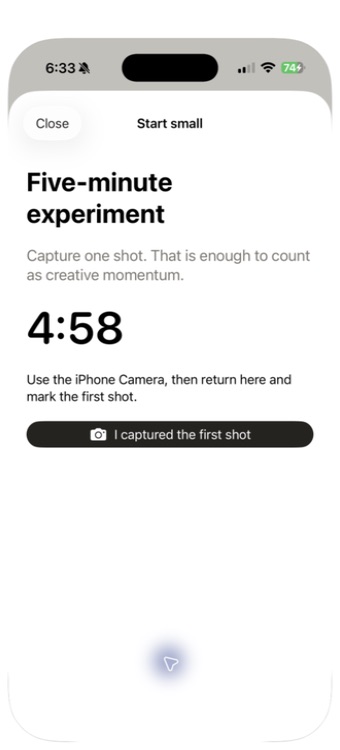
Five minutes. One shot. It explicitly does not ask you to finish anything or post anything — the button only claims that a first frame now exists. Every feature that asked for more than this had already been removed.
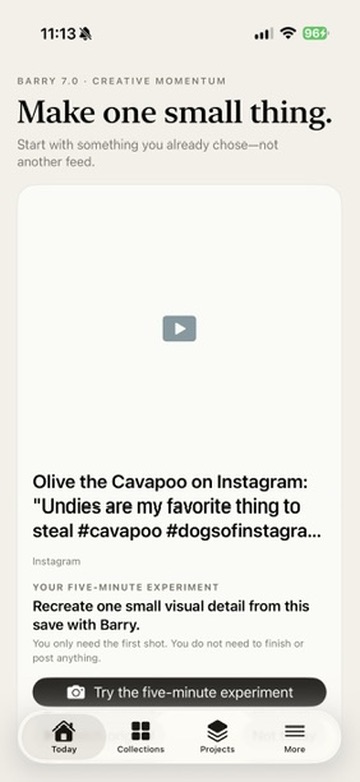
Instagram and TikTok do not permit their video to render inside another app. So at the exact moment the product asks you to act on something, it can only show you a blank frame and a caption, and offer to send you back to the feed you came from.
That is a design problem I cannot design around. Sending someone back to the platform to see what they saved returns them to an infinite feed — which is the behavior the product exists to interrupt. Every workaround I have tried either breaks the terms or breaks the moment.
Two wrong answers is the useful part.
I did not set out to build a content organizer twice. I set out to make more things, watched myself not do it, and let that evidence overrule what I had already built — including the parts I liked.
Version seven is smaller than version one by every measure. That is what the testing produced: not a bigger product, a narrower bet. And the honest state of it is that the bet is currently blocked by a platform decision rather than by the idea being wrong.
I am the product manager on this, not the engineer. AI writes most of the code. What I own is which problem is worth solving, what gets cut, how it should feel, and whether the evidence says it worked.
Product strategy · UX direction · feature prioritization · QA and device testing · AI-assisted development · iteration on observed behavior
Screens from the current build, captured on device · one user · no adoption, engagement, or performance figures claimed · the product is not finished and the core problem is not solved